Building Bridges: Strategies for Embracing Commonalities and Managing Political Differences
In today’s polarized political climate, workplace harmony can be challenging to maintain. Recent data highlights the extent of this challenge:
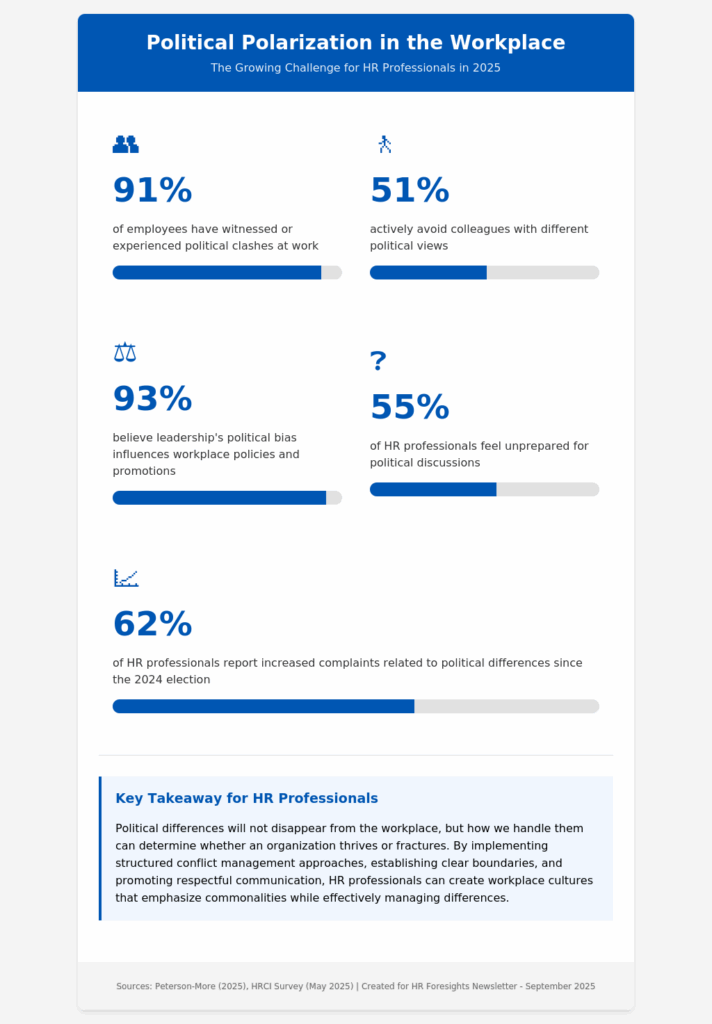
These statistics underscore the need for proactive strategies to create a workplace culture that emphasizes what employees have in common while effectively managing political differences. Here are evidence-based approaches to achieve this balance:
1. Understand the Difference Between Conflict Resolution and Conflict Management
When addressing political differences in the workplace, it’s important to recognize that some conflicts can be resolved, while others can only be managed. As Peterson-More (2025) explains:
- Conflict resolution works with disagreements that can be solved, settled, or finalized. These are matters that focus on facts.
- Conflict management recognizes that some conflicts, especially those rooted in deeply held values like political beliefs, may never be resolved—but they can be managed productively.
By approaching political differences through the lens of conflict management rather than expecting resolution, HR professionals can create more realistic expectations and effective strategies for maintaining workplace harmony.
A particularly effective technique is implementing “active listening protocols” from HRCI’s May 2025 whitepaper: Pause debates to validate emotions before seeking common ground, which has been shown to reduce escalation by 40% in pilot programs. This approach complements the conflict management framework by acknowledging feelings before moving to solutions.
2. Establish Clear Boundaries and Communication Channels
While many companies understandably shy away from politics—with 36% discouraging political discussion—employees need opportunities to discuss political problems when they arise in the workplace (HRCI Team, 2025). Consider these approaches:
- Establish accessible channels for addressing concerns, such as third-party mediation or company-appointed ombudspersons
- Conduct training to help employees understand conflict styles and resolution techniques
- Set clear expectations that all workplace communication will be respectful and appropriate
- Communicate these expectations during onboarding, company town halls, and team-building events
3. Implement a Structured Conflict Management Approach
Peterson-More (2025) proposes a four-step process that can be applied even in the most contentious workplace disagreements:
- Define the issue from two divergent perspectives: Clearly articulate opposing viewpoints without judgment.
- Identify the areas of disagreement: Pinpoint the core issues causing workplace tension.
- Find common ground: Despite strong differences, most people can agree on foundational principles, such as:
- All employees deserve a workplace free from harassment and hostility
- Productivity and collaboration should not suffer due to political divisions
- Leadership should foster an environment of respect and fairness
- Develop strategies and actions to build upon common ground: Once shared values are identified, create policies and practices that uphold them.
4. Set Boundaries and Promote Respect
Establishing and respecting boundaries is essential when managing political conversations in the workplace. According to SHRM’s 2025 guide on workplace civility during elections, effective strategies include:
- Politely steer conversations back to work-related matters when political topics arise
- Encourage a workplace culture that values respect and inclusivity
- Acknowledge that colleagues may have diverse opinions and that everyone has a right to their own beliefs
- Focus on finding common ground with colleagues rather than dwelling on divisive political issues
5. Develop Clear Policies and Promote Professionalism
Developing and enforcing clear policies regarding political expression in the workplace is important. These policies should:
- Outline acceptable behavior and provide guidelines for addressing conflicts
- Specify that political discussions should not occur during meetings or in common work areas
- Prohibit any form of harassment or intimidation based on political beliefs
- Reinforce the importance of professionalism in all interactions
6. Understand Legal Considerations
While political affiliation isn’t a federally protected class under Title VII, harassment tied to it can violate laws if linked to race, religion, or national origin (EEOC guidance, updated March 2025). In 12 states (e.g., California, New York), political beliefs are explicitly protected, risking lawsuits for retaliation. HR professionals should audit their policies for compliance, especially with rising political tensions in workplaces.
7. Embrace an Inclusive Approach to Workplace Culture
According to Catalyst (2025), an overarching trend among strategic, forward-focused organizations is to embed workplace inclusion into core business strategies. This includes:
- Gender partnership: Driving equity and culture change by recognizing men as crucial partners and beneficiaries in fostering gender equity
- Generational diversity: Addressing biases and stereotypes about both older and younger employees to foster collaboration and innovation. Gen Z (now 27% of the workforce) is twice as likely to disengage due to political clashes, per Catalyst’s September 2025 neurodiversity update, as they prioritize “psychological safety” in discussions. Consider tailoring training specifically for this cohort.
- Neurodivergence, disability, and accessibility: Embracing physical and cognitive differences to enhance workplace culture and drive innovation
By focusing on these inclusive approaches, organizations can create environments where differences—including political ones—are respected and valued rather than becoming sources of division.
Key Takeaway for HR Professionals
Political differences will not disappear from the workplace, but how we handle them can determine whether an organization thrives or fractures. By implementing structured conflict management approaches, establishing clear boundaries, promoting respectful communication, and embracing inclusive practices, HR professionals can create workplace cultures that emphasize commonalities while effectively managing differences. This approach not only reduces conflict but also enhances employee satisfaction, productivity, and retention.
Consider piloting the four-step conflict management process in your Q4 2025 town halls to begin building a more harmonious workplace culture.
Disclaimer: This article was AI assisted, not AI generated. The content of this newsletter was developed through collaboration between human expertise and AI assistance. While artificial intelligence tools were used to help gather information, organize content, and enhance readability, all editorial decisions, professional judgments, and final content approval were made by human HR professionals. The perspectives, recommendations, and insights presented reflect human expertise in employment law and workplace culture management.
References
Catalyst. (2025, February 4). 10 inclusive workplace trends for 2025. https://www.catalyst.org/enus/
insights/2025/10-inclusive-workplace-trends
Catalyst. (2025, September). Neurodiversity update: Generational differences in workplace political engagement. Catalyst Research Series.
Equal Employment Opportunity Commission. (2025, March). Guidance on political expression in the workplace.
EEOC Compliance Manual.
HRCI Team. (2025, May). Managing workplace polarization whitepaper. HR Certification Institute.
HRCI Team. (2025, June 10). Building a positive culture around politics. HR Certification Institute.
https://www.hrci.org/community/blogs-and-announcements/hr-leads-business-blog/hr-leadsbusiness/
2025/06/10/managing-political-discussions-strategies
Peterson-More, D. (2025, February 26). “Can we all just get along?” Rodney King: Tips for combatting the political
divide in the workplace. https://dianapetersonmore.com/2025/02/26/can-we-all-just-get-along-rodney-king-tipsfor-
combatting-the-political-divide-in-the-workplace/
SHRM. (2025). Guide to workplace civility during elections. Society for Human Resource Management.
For more information, contact Krystal Woolley,sHRBP kwoolley@noveltyhr.com